
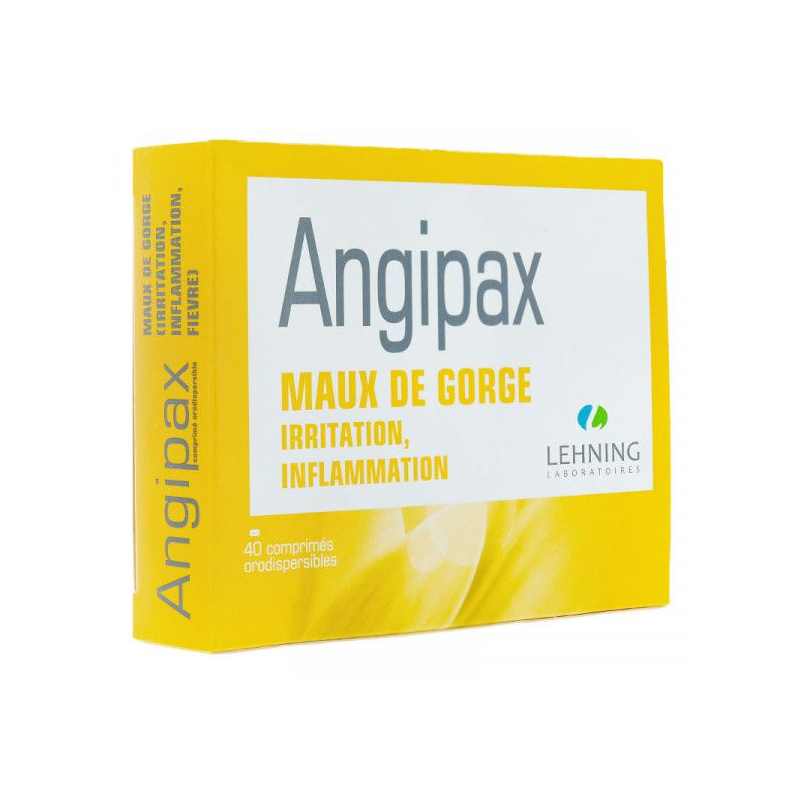

Homoeopathic medicine traditionally used to treat non-bacterial throat infections (e.g. inflammation, pain, redness or fever). Created by Laboratoires Lehning.

Secure payment

Fast delivery, careful packaging

Efficient customer service
Angipax is a homeopathic medicine traditionally used to treat non-bacterial angina (inflammation, pain, redness, fever). We recommend that you are certain of the type of angina you suffer from before choosing your treatment.
Angipax is taken sublingually.
Allow the tablet to melt under the tongue, preferably outside of mealtimes.
In children under 6 years of age, dissolve the tablet in a little water before taking it, as there is a risk of misdirection.
It is recommended to take 2 tablets 2 to 4 times a day for adults and 1 tablet 2 to 4 times a day for children.
For children under 3 years of age, medical advice is recommended.
Repeat every 3 to 6 hours.
Spacing out the doses as soon as they improve and stop taking them as soon as the symptoms disappear. The maximum duration of treatment is 5 days.
If symptoms persist, consult your doctor.
If your doctor has informed you of an intolerance to certain sugars, contact him or her before taking this medicine.
Be careful with Angipax, orodispersible tablet, the use of this medicine is not recommended in patients with: galactose intolerance, Lapp lactase deficiency, glucose or galactose malabsorption syndrome (rare inherited diseases).
Due to the presence of the Pulsatilla strain in the formula, this medicine should not be used in cases of otitis or sinusitis without medical advice.
Never take Angipax, orodispersible tablet: In case of phenylketonuria (hereditary disease detected at birth), due to the presence of aspartam. Hypersensitivity to any of the ingredients.
Ask your doctor or pharmacist for advice before taking Angipax.
The active ingredients are (for one 250 mg orodispersible tablet): - Apis mellifica 4 DH
Apis mellifica 4 DH: 12.5 mg; Belladonna 4DH: 12.5 mg; Mercurius corrosivus 8 DH: 12.5 mg; Mercurius solubilis 8 DH: 12.5 mg; Phytolacca decandra 4 DH: 12.5 mg; Pulsatilla vulgaris 4 DH: 12.5 mg
Notable excipient: lactose.

Specific References
Homoeopathic medicine traditionally used to treat non-bacterial throat infections (e.g. inflammation, pain, redness or fever). Created by Laboratoires Lehning.