
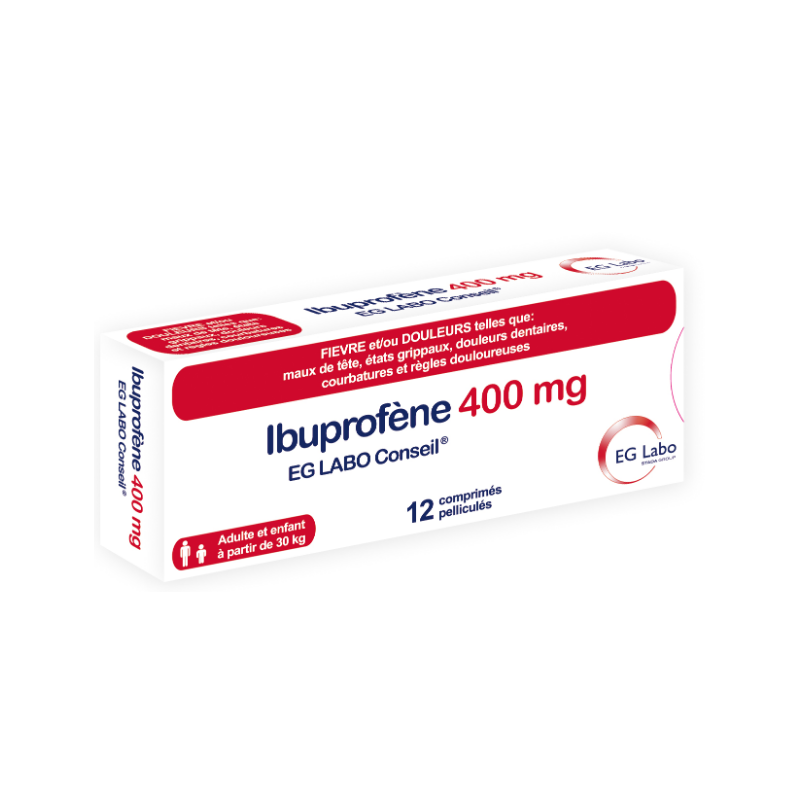

This medicine contains a non-steroidal anti-inflammatory drug: ibuprofen.

Secure payment

Fast delivery, careful packaging

Efficient customer service
This medicine contains a non-steroidal anti-inflammatory drug: ibuprofen. It is indicated in adults and children weighing more than 30 kg (approximately 11-12 years) for the short-term treatment of fever and/or pain such as headaches, flu-like symptoms, toothache, aches and painful periods. It is indicated in adults, following at least one medical opinion, for the treatment of mild to moderate migraine attacks, with or without aura.
FOR ADULTS AND CHILDREN FROM 30 kg UP (approximately 11-12 years).
The usual dose is 1 tablet (400 mg) per dose, repeated if necessary after 6 hours. In all cases, do not exceed 3 tablets per day (i.e. 1200 mg per day).
To reduce symptoms, the lowest effective dose should be used for the shortest possible time. If you have an infection and symptoms (such as fever and pain) persist or worsen, consult a doctor immediately.
Swallow the tablet without chewing, with a large glass of water. The tablets should preferably be taken with a meal.
- The active substance is :
Ibuprofen..................................................................................................................... 400 mg
- The other ingredients are :
Maize starch, magnesium stearate, sodium carboxymethyl starch, hypromellose, macrogol 400, macrogol 6000.
In high doses, in excess of 1200 mg/day, this medicine has anti-inflammatory properties and may cause the sometimes serious side effects observed with non-steroidal anti-inflammatory medicines. Anti-inflammatory/antalgic drugs such as ibuprofen are likely to be associated with a slightly increased risk of heart attack or stroke, particularly when used in high doses. Do not exceed the recommended dose or duration of treatment.
Discuss your treatment with your doctor or pharmacist before taking IBUPROFENE EG LABO CONSEIL 400 mg if you:
- have heart problems, including heart failure, angina (chest pain) or if you have had a heart attack, bypass surgery, peripheral arterial disease (poor circulation in the legs or feet due to narrowed or blocked arteries) or any kind of stroke (including ‘mini-strokes’ or transient ischaemic attacks (TIAs));
- have high blood pressure, diabetes, high cholesterol, a family history of heart disease or stroke, or are a smoker.
If you are pregnant or breastfeeding, think you might be pregnant or are planning to become pregnant, ask your doctor or pharmacist for advice before taking any medicine.
Pregnancy
From the beginning of the 6th month (24th week of amenorrhoea) until the end of pregnancy, IBUPROFENE EG LABO CONSEIL 400 mg, film-coated tablet is contraindicated.
During this period, you must under NO CIRCUMSTANCES take this medicine, as its effects on your unborn child may have serious or even fatal consequences. In particular, toxicity to the heart, lungs and/or kidneys has been observed, even with a single dose. It can also have repercussions on you and your baby by increasing bleeding and leading to a later or longer than expected delivery.
Before the start of the 6th month (up to the 24th week of amenorrhoea) or if you are planning a pregnancy, you should not take this medicine unless absolutely necessary. This will be determined by your doctor. In such cases, the dose should be as low as possible and the duration of treatment as short as possible.
NSAIDs, including IBUPROFENE EG LABO CONSEIL 400 mg, film-coated tablet, can cause miscarriage and, in some cases, malformations after exposure in early pregnancy.
From 2 and a half months of pregnancy (12 weeks of amenorrhoea), IBUPROFENE EG LABO CONSEIL 400 mg, film-coated tablet may cause kidney problems in your baby if taken for several days, which may result in a low level of amniotic fluid in your baby (oligohydramnios).
From the beginning of the 5th month of pregnancy (20 weeks of amenorrhoea), a narrowing of the blood vessels around your baby's heart (constriction of the ductus arteriosus) may be observed. If treatment lasting several days is necessary during the 5th month of pregnancy (between 20 and 24 weeks of amenorrhoea), your doctor may recommend additional monitoring.
If you have taken this medicine while pregnant, tell your doctor immediately, so that you can be offered appropriate monitoring if necessary.
Breast-feeding
As this medicine passes into breast milk, it is not recommended to use it while breast-feeding.

Specific References
This medicine contains a non-steroidal anti-inflammatory drug: ibuprofen.